Table of Contents
More Than Just a Match
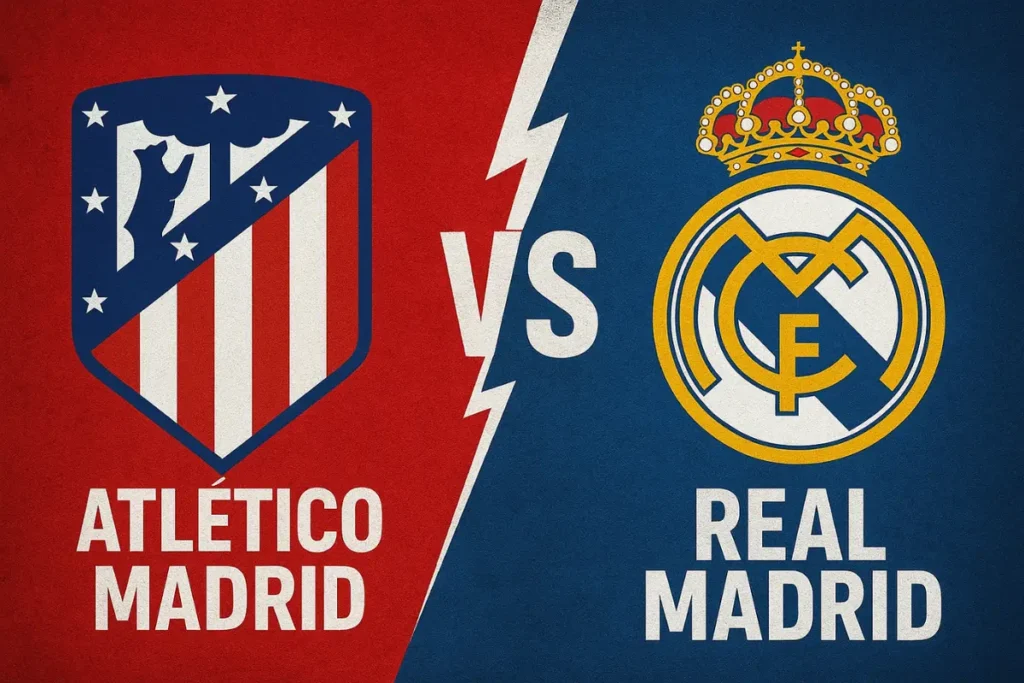
There are football rivalries, and then there are football wars. In Spain, the world knows El Clásico—the fierce battle between Real Madrid and Barcelona. But ask any Madrileño, and they’ll tell you that the true heartbeat of the capital lies in the Atlético Madrid vs Real Madrid rivalry.
It’s not simply about points on a table. It’s about identity, pride, and belonging. Real Madrid represents glamour, power, and European dominance, while Atlético embodies grit, resilience, and the soul of the working class. Every time the two sides meet, Madrid itself divides in half. Families sit at the dinner table unable to cheer in unison, bars in Malasaña or Chamartín erupt with chants on opposite sides, and the city feels like a cauldron of red, white, and royal white.
This is the story of Atlético Madrid vs Real Madrid—a rivalry as dramatic and emotional as football gets.
The Roots of a Capital Derby
The rivalry was born almost as soon as football took root in Spain. Real Madrid, founded in 1902, quickly grew into a symbol of prestige and authority. Atlético Madrid, established in 1903 by Basque students, carried a very different spirit: that of defiance and working-class pride.
By the 1920s and 30s, when football began to intertwine with politics and society, these identities only deepened. Real Madrid, with their royal patronage and later Franco-era associations, were often seen as the team of the establishment. Atlético, meanwhile, became the banner for those who resisted the dominance of the powerful.
The first official derby took place in 1929, in the very first La Liga season. Real Madrid won 2-1, setting the tone for decades of heated clashes. But Atlético never backed down; each match was more than a game—it was a battle of two Madrids.
Identities in Contrast: The Glamour vs the Grit
If you walk into the Santiago Bernabéu Stadium, you feel the aura of global royalty. This is the home of 13-time European champions, where players like Cristiano Ronaldo, Zinedine Zidane, Alfredo Di Stéfano, and Karim Benzema built their legends. Real Madrid is synonymous with Champions League nights, Galácticos, and international prestige.
Now travel across town to Cívitas Metropolitano (and before, the Vicente Calderón), and the atmosphere changes. Here, fans sing “Nunca dejes de creer” (“Never stop believing”). Atlético’s history is filled with heartbreak, near-misses, and dramatic comebacks. Yet, that suffering has shaped an identity built on loyalty and resilience. Players like Diego Simeone, Fernando Torres, Diego Forlán, and Antoine Griezmann became symbols of fight and passion.
The two clubs represent two sides of Madrid’s heart:
- Real Madrid: ambition, dominance, glamour, “win at all costs.”
- Atlético Madrid: struggle, humility, family, the underdog spirit.
This contrast fuels every derby.
Legendary Clashes in History
The 1950s: A Rivalry in the Making
The 1950s saw Atlético winning back-to-back La Liga titles under Helenio Herrera, while Real Madrid built the foundations of European dominance with Di Stéfano. These early years proved one thing: Madrid was the center of Spanish football.
The 1970s: Atlético’s Resistance
Real Madrid often dominated La Liga, but Atlético were the only true challenger in that era. They captured league titles and even reached the 1974 European Cup Final, where heartbreak awaited them. Still, within Spain, beating Real Madrid meant everything.
The 1990s: Derby Chaos
Derbies in the 1990s were pure fire. Fans remember Simeone the player (before he became Atlético’s coach), clashing with Madrid legends like Hierro and Raúl. Matches often descended into gritty battles, with red cards and late goals becoming the norm.
2014 Champions League Final: Lisbon Heartbreak
No rivalry moment stings Atlético fans more than May 24, 2014. Atlético led 1-0 against Real Madrid in the Champions League Final in Lisbon. Victory was seconds away—until Sergio Ramos scored in the 93rd minute. In extra time, Real Madrid demolished a broken Atlético, winning 4-1.
For Atlético fans, it was heartbreak on the grandest stage. For Real Madrid fans, it was “La Décima”—their tenth European Cup.
2016 Champions League Final: The Penalty Shootout
Two years later, Atlético got another chance in Milan. This time, the match ended 1-1 after extra time. Penalties followed. Cristiano Ronaldo scored the winning kick, and once again, Atlético fell to their city rivals in the cruelest way possible.
These back-to-back finals cemented Real Madrid’s dominance, but also carved Atlético’s identity as the eternal fighters who never stop believing.
Simeone vs the Galácticos
When Diego Simeone returned to Atlético as coach in 2011, he transformed the rivalry. Simeone’s philosophy—“partido a partido” (one game at a time)—resonated with the fans. His team played with intensity, pressing, and defensive solidarity.
Under his leadership, Atlético finally broke Real Madrid’s stranglehold. In 2013, they defeated Real Madrid in the Copa del Rey Final at the Bernabéu—on Real’s own turf. In 2014, Atlético won La Liga, celebrating in Barcelona but knowing they had dethroned Madrid’s dominance in the capital.
Real Madrid, of course, still had their Galácticos. Cristiano Ronaldo scored freely against Atlético, while players like Gareth Bale and Luka Modrić embodied Madrid’s star power. But Simeone made every derby a fight. The gap had narrowed.
Stories from the Stands: Fans and Passion
To understand this rivalry, you must listen to the fans.
For a Real Madrid supporter, beating Atlético is about confirming superiority. “We are the kings of Europe, and Madrid is ours,” they chant. For them, Atlético is the little brother—annoying, feisty, but ultimately in the shadow.
For an Atlético fan, victory over Real Madrid means justice. It means showing the world that loyalty and heart can defeat money and glamour. They wave banners that say: “Orgullo, Coraje y Corazón” (Pride, Courage, and Heart).
Walking through Madrid on derby day feels like stepping into a divided city. Metro lines fill with chants, streets near the stadiums turn into oceans of red-and-white or white jerseys, and inside the grounds, the noise is deafening.
Head-to-Head by the Numbers
- Total Matches (all competitions): Over 230 official derbies.
- Real Madrid Wins: ~115+
- Atlético Madrid Wins: ~60+
- Draws: ~60
- Biggest Win: Real Madrid 5-0 (1983).
- Atlético’s Iconic Win: 4-0 at the Calderón in 2015 (Griezmann era).
While Real Madrid hold the statistical upper hand, every victory for Atlético carries monumental emotional weight.
Key Players Who Defined the Derby
- Real Madrid: Alfredo Di Stéfano, Raúl, Cristiano Ronaldo, Sergio Ramos, Luka Modrić, Karim Benzema, Brahim Díaz.
- Atlético Madrid: Luis Aragonés, Diego Simeone, Fernando Torres, Diego Godín, Antoine Griezmann, Jan Oblak.
Each of these players brought unique stories—Di Stéfano’s class, Ramos’ last-minute heroics, Torres’ boyhood passion, Oblak’s saves that defy logic.
The Rivalry Today: A Modern Battle
Today, the rivalry is as alive as ever. Real Madrid, now led by superstars like Kylian Mbappé, Vinícius Jr., and Jude Bellingham, continue their quest for European domination. Atlético, with Simeone still at the helm, build on a philosophy of resilience, relying on stars like Griezmann, Oblak, and Julián Álvarez.
Every clash between them feels like a story within a story:
- Can Atlético finally overcome their “little brother” label?
- Will Real Madrid prove once more that dominance runs in their veins?
- Which side of Madrid sings louder when the final whistle blows?
Anecdotes: The Derby in Personal Stories
- The Father and Son Divide: In Madrid, it’s not uncommon for families to split loyalties. A father might wear the white of Madrid, while his son proudly dons Atlético red-and-white. Derby day becomes a test of family patience—and bragging rights last until the next clash.
- The “Never Stop Believing” Banner: After the heartbreak of Lisbon 2014, Atlético fans unfurled a massive banner reading “Nunca dejes de creer.” It wasn’t just a slogan; it became the anthem of their identity, sung every time they faced Real.
- The Neighborhood Battle: In working-class neighborhoods like Vallecas, you’ll often find more Atlético flags hanging from balconies. In affluent areas like Salamanca, the white of Real Madrid shines brighter. The city itself wears its football loyalties on its walls.
Why the Rivalry Will Never Die
Football is about more than goals—it’s about stories, passion, and belonging. The Atlético Madrid vs Real Madrid rivalry is not going anywhere because it is woven into the identity of the city itself.
It is the underdog versus the giant. It is grit versus glamour. It is every child in Madrid deciding which side they belong to—and carrying that loyalty for life.
As long as there are fans to cheer and a ball to kick, Madrid will remain divided on derby day. And the world will watch, knowing that in this rivalry, anything can happen.
Conclusion: The Eternal Derby
The Atlético Madrid vs Real Madrid rivalry is more than 90 minutes of football. It is history, culture, and raw emotion. It is heartbreak and triumph. It is Lisbon 2014 tears and Calderón 2015 euphoria. It is Ramos’ header and Torres’ roar.
It is, quite simply, the soul of Madrid played out on the pitch.
For fans around the world, it’s a derby to admire. For those in Madrid, it’s life itself.
Frequently Asked Questions about Atlético Madrid vs Real Madrid
How many times have Atlético Madrid vs Real Madrid played each other?
Atlético Madrid vs Real Madrid have faced each other over 230 times in official competitions, with Real Madrid holding more wins overall.
Who has won more titles, Atlético Madrid or Real Madrid?
Real Madrid have won significantly more La Liga and Champions League titles compared to Atlético Madrid, but Atlético remains a consistent force in Spanish football.
What is the biggest Atlético Madrid vs Real Madrid win?
Real Madrid’s biggest derby win was a 5-0 victory in 1983. Atlético’s most famous triumph was a 4-0 win in 2015 at the Vicente Calderón.
Why is the Atlético Madrid vs Real Madrid rivalry so intense?
The rivalry is fueled by contrasting identities: Real Madrid represents power and glamour, while Atlético Madrid symbolizes resilience and working-class pride.
When is the next Atlético Madrid vs Real Madrid match?
The next Atlético Madrid vs Real Madrid derby takes place in the 2025 La Liga season, with dates depending on the league schedule.